Burr vs Blade: Particle Distribution
If there is one absolute truth in coffee science, it is this: your extraction is entirely bounded by the quality of your grinder. A high-end espresso machine fed by a subpar grinder will produce a worse shot than an entry-level machine paired with precision burrs.
The Blade Grinder Fallacy
Blade grinders do not grind; they chop. A spinning blade creates chaotic impacts, resulting in a particle distribution that contains macroscopic chunks (boulders) and microscopic dust (fines). During extraction, water channels through the boulders, leaving them under-extracted and sour, while over-extracting the fines, creating harsh bitterness. The result is a muddy, confused cup.
Burr Geometry: Flat vs Conical
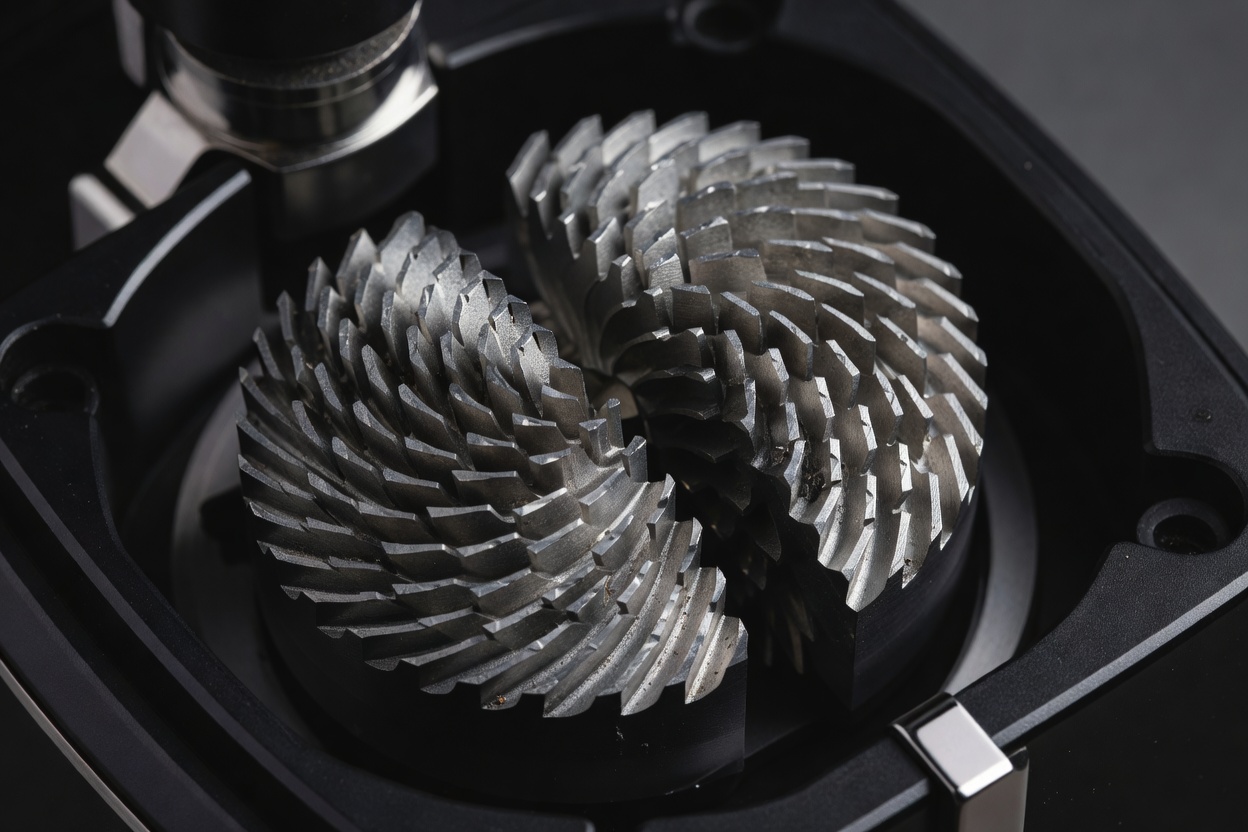
Precision grinders use two interlocking burrs—one stationary, one rotating—to crush beans to an exact size determined by the distance between them. This produces a tight grind distribution curve, essential for even extraction.
Flat Burrs
Two parallel, ring-shaped burrs. Coffee is forced horizontally outward by centrifugal force. They produce a highly unimodal grind distribution (particles are strictly the same size). This highlights flavor clarity and distinct origin notes, though it can sometimes produce a lighter body.
Conical Burrs
A cone-shaped inner burr rotates inside a ring-shaped outer burr. Coffee falls through via gravity. They naturally produce a bimodal distribution (two peaks of particle sizes). This generates a thicker body and enhanced mouthfeel, making them traditional favorites for classic espresso.
RPM and Heat Generation
Commercial grinders manage thermal retention and friction. High RPMs can heat the burrs, which in turn heats the coffee grounds, prematurely beginning the extraction process and off-gassing volatile aromatics. This is why many high-end single-dose grinders operate at lower RPMs or feature massive heat sinks and cooling fans.