The Mechanics of Manual Brewing
Unlike the high-pressure environment of espresso, pour-over brewing relies on gravity. This gentle extraction method highlights the delicate floral, fruity, and tea-like notes in specialty coffees. But simplicity is deceptive; gravity brewing requires rigorous control over agitation, flow rate, and temperature.
Gooseneck Kettles: Laminar Flow Control
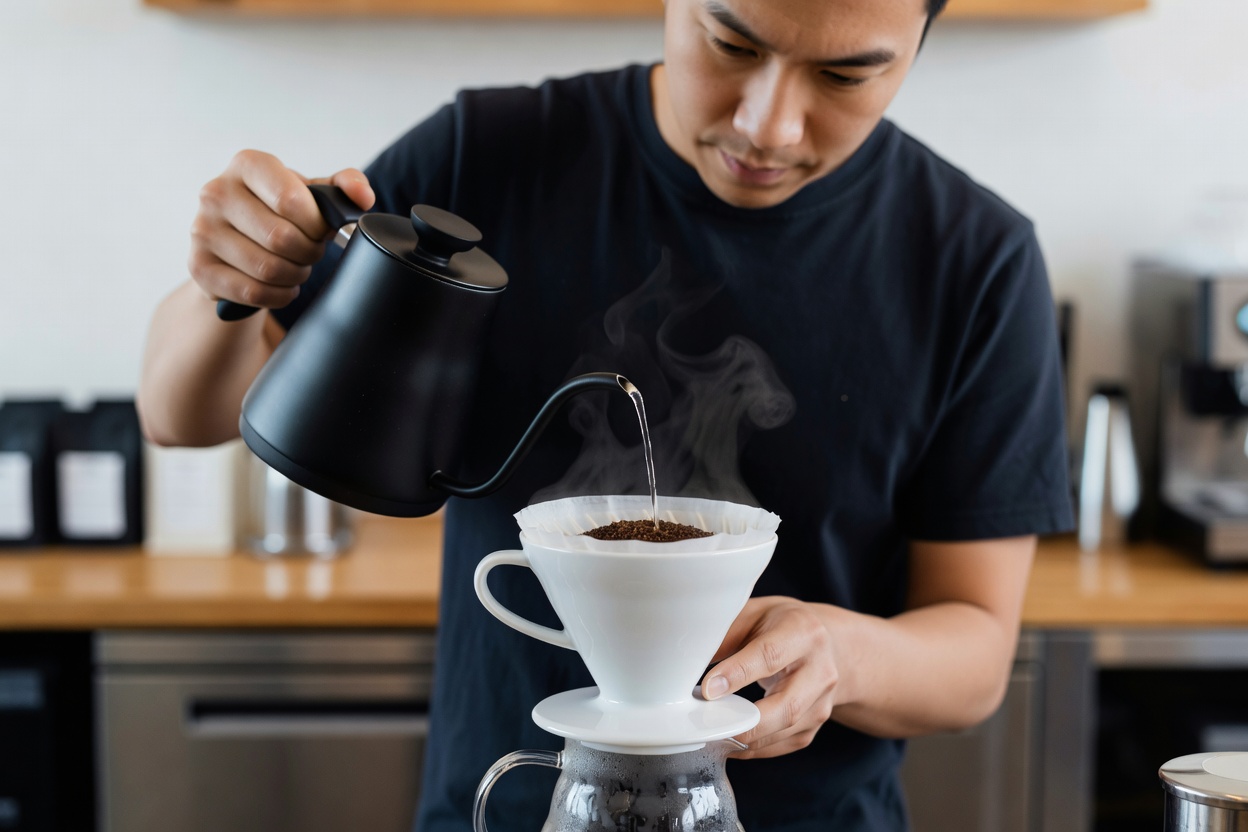
The iconic gooseneck kettle isn't just an aesthetic choice. The long, tapered spout ensures laminar flow—a smooth, uninterrupted stream of water that doesn't plunge forcefully into the coffee bed. Heavy agitation causes fines (microscopic coffee particles) to migrate to the bottom of the filter, clogging the paper and stalling the drawdown.
Understanding the Bloom
Freshly roasted coffee contains trapped carbon dioxide. When hot water hits the grounds, this gas rapidly escapes, causing the coffee bed to swell or "bloom." If you attempt to brew without blooming, the escaping gas repels the water, leading to severe under-extraction. A standard bloom uses twice the weight of the coffee in water (e.g., 30g of water for a 15g dose) and lasts 30 to 45 seconds.
Dripper Geometry: Conical vs. Flat Bottom
The shape of your brewer profoundly impacts extraction dynamics:
Conical Brewers (e.g., Hario V60, Chemex)
These brewers force water to travel through a deeper, central point of the coffee bed. This accelerates flow and encourages higher extraction rates, often resulting in brighter, cleaner cups with accentuated acidity.
Flat-Bottom Brewers (e.g., Kalita Wave, Orea)
Flat bottoms restrict flow and spread the coffee bed horizontally. This promotes more even contact time across all grounds, yielding a sweeter, fuller-bodied cup and a more forgiving brewing process.
Mastering pour-over requires understanding how your pouring technique interacts with these geometries to maintain a consistent slurry temperature and extraction rate.